
The most famous lost city in human history exists in exactly two documents. Both were written by the same man, around 360 BC, in Athens. One of them was never finished.
Plato's Timaeus and Critias contain every word that anyone in the ancient world ever recorded about Atlantis. No Egyptian papyrus mentions it. No Babylonian tablet references it. No Greek writer before Plato describes it, and his own student Aristotle apparently believed his teacher made the whole thing up [1]. Twenty-four centuries later, the story has generated over 100 proposed locations, a Netflix series, and a permanent fixture in the Western imagination. Between 2000 and 2011 alone, 98 separate claims were made to have found the real-world location of Atlantis [22].
What Plato actually described was specific: an island "larger than Libya and Asia together," lying beyond the Pillars of Heracles (the Strait of Gibraltar), home to a great naval empire that attacked Europe and was repelled by ancient Athens. Poseidon's descendants ruled it. Concentric rings of water and land surrounded a central hill. Walls gleamed with brass, tin, and a mysterious metal called orichalcum. Then, "in a single day and night of misfortune," the island sank beneath the sea [1].
The date Plato gave was staggering: 9,000 years before the lawgiver Solon's visit to Egypt, placing the catastrophe around 9,600 BC. That number, coincidentally or not, falls squarely within one of the most violent climate transitions in human prehistory. And that coincidence is where the interesting questions begin.
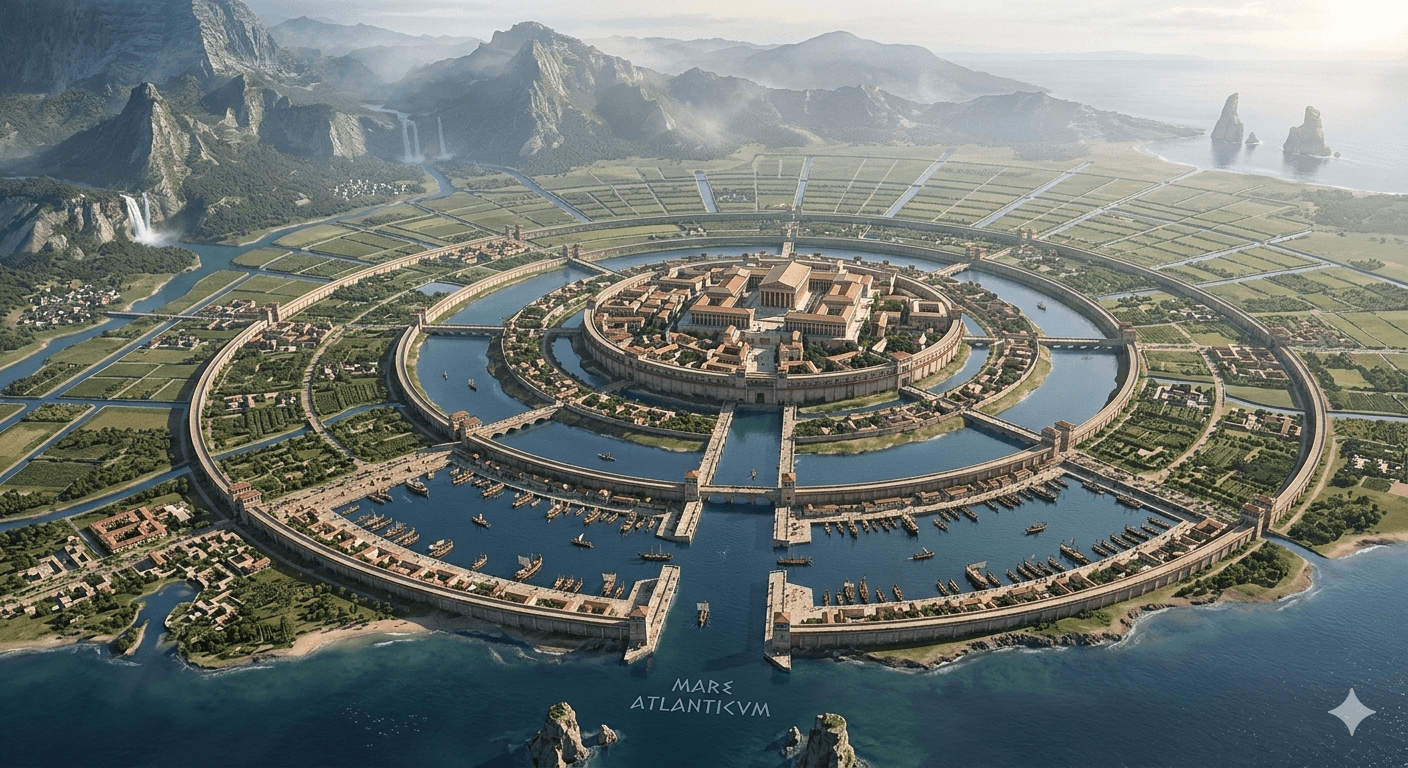
What Plato Was Actually Doing
The standard reading of Atlantis among classicists is not a matter of debate. It is one of the most settled questions in the field.
Christopher Gill's 1979 analysis in Philosophy and Literature argued that the Atlantis narrative represents one of the earliest sustained works of literary fiction in Western tradition [2]. The evidence is structural: the story appears only in two late-career dialogues where Plato was explicitly dramatizing how his ideal state, described in the Republic, would perform in practice. Athens, modeled on Plato's perfect polis, defeats a corrupt maritime empire. The allegory is a morality play about civic virtue, not a history lesson.
Gerard Naddaf, writing in Phoenix, placed the Atlantis myth within Plato's broader philosophy of historical cycles. The 9,000-year figure, Naddaf argued, aligns with Egyptian priestly traditions about cosmic cycles and floods, lending Plato's narrative a veneer of ancient authority without establishing historical grounding [3]. K. A. Morgan's analysis in the Journal of Hellenic Studies went further, identifying specific fourth-century Athenian events that Plato drew upon: the catastrophic Athenian invasion of Sicily in 415-413 BC (a real empire destroyed by hubris) and the destruction of Helike in 373 BC, an actual Greek city swallowed by the sea during Plato's own lifetime [4].
The supposed verification trail has also been dismantled. Alan Cameron's examination of the oft-cited claim that Crantor, Plato's student, independently confirmed Atlantis through Egyptian records found that this rests on a misreading of Proclus, a Neoplatonist writing eight centuries after Plato. No known Egyptian inscription, papyrus, or archaeological find has ever mentioned Atlantis [5].
The transmission chain itself should give anyone pause. The story supposedly passed from Egyptian priests at Sais to the Athenian statesman Solon around 590 BC, then through four oral generations (Solon to Dropides to the elder Critias to the younger Critias) before reaching Plato. Solon never wrote any of it down. And the Critias dialogue breaks off mid-sentence, unfinished. If Plato considered this a crucial historical record, abandoning it without explanation is difficult to account for.
None of this means Plato invented Atlantis from nothing. Real catastrophes informed his imagination. The Minoan eruption of Thera around 1600 BC, one of the largest volcanic events in recorded human history, devastated Akrotiri and generated tsunamis across the eastern Mediterranean [6]. Egyptian records plausibly preserved memories of the event, and scholars including J. Gwyn Griffiths have built a credible case that garbled accounts of this eruption reached Plato via Solon's Egyptian contacts [24]. The problem is the timeframe: Thera erupted about 8,000 years later than Plato's 9,600 BC date. One proposed solution is a factor-of-ten transmission error (Egyptian "seasons" mistranslated as "years"), which would place the Thera eruption comfortably within Plato's chronology [6]. It is a tidy explanation, though unverifiable.
How Allegory Became History
Plato's philosophical invention spent most of its existence understood as exactly that. Roman and medieval scholars treated it as a literary device. The transformation of Atlantis from a thought experiment into a supposedly real place is largely a modern phenomenon.
The pivot came in 1882, when Ignatius Donnelly, a Minnesota congressman with a flair for grand synthesis, published Atlantis: The Antediluvian World. Donnelly's book argued that all ancient civilizations descended from a single Atlantic island culture, that the gods of mythology were the deified kings of Atlantis, and that its destruction was preserved in universal flood myths. The book became a bestseller. Its intellectual framework, which scholars would later classify as "hyperdiffusionism" (the idea that all cultural innovation radiates from a single source), would prove remarkably durable.
Over a century later, Graham Hancock refined Donnelly's template for a new audience. Fingerprints of the Gods (1995) and Magicians of the Gods (2015) proposed that an advanced civilization flourished during the last Ice Age, was destroyed by a comet impact triggering the Younger Dryas around 12,900 years ago, and its survivors migrated globally, teaching agriculture and monumental architecture to hunter-gatherer populations [18]. Netflix's Ancient Apocalypse series (2022, 2024) brought the hypothesis to millions of viewers.
Hancock's claims rest on several pillars. Göbekli Tepe's sophistication, he argues, proves complex civilization predates the standard archaeological timeline. Astronomical alignments of ancient monuments supposedly encode knowledge from 10,500 BC. The near-universality of flood myths points to a real global cataclysm. Underwater structures off Japan and the Bahamas are physical remnants of the drowned cities.
Each pillar has been examined and found wanting by independent researchers. Göbekli Tepe is remarkable, but it contains no metal, no writing, no agriculture, and no urban planning; its builders were hunter-gatherers [12]. The astronomical alignment methodology has been widely criticized for statistical cherry-picking — given thousands of ancient monuments worldwide, some will align with star positions at any chosen date by chance alone [19]. Flood myths are better explained by the fact that most human cultures lived near water and experienced local flooding; post-glacial sea level rise would independently generate inundation stories across unconnected coastal cultures [19]. Yonaguni has been examined by geologists who identify natural rock formations; Bimini Road is naturally occurring beach rock [19].
Hancock has not submitted his hypotheses for peer review. Anthropologist Jeb Card has characterized the "Ice Age civilization" framework as a modern mythic narrative descended from nineteenth-century hyperdiffusionism [18]. Archaeologist Flint Dibble of Cardiff University has argued that Ancient Apocalypse "cherry picks evidence, fails to present counter-evidence, and delegitimizes Indigenous achievement" by implying that local populations could not have developed complex cultures without outside teachers [18].
More recently, the Richat Structure in Mauritania — a 40-kilometer-diameter circular geological dome in the Sahara — went viral on YouTube as a proposed Atlantis candidate. Its concentric rings superficially resemble Plato's description. But the Richat Structure is approximately 100 million years old, sits 500 kilometers inland in a desert, shows no evidence of ancient ocean covering the area, and has yielded no archaeological evidence of any human settlement, let alone an advanced civilization [26].
The World That Actually Drowned
Strip away the mythology, and something genuinely extraordinary happened between 20,000 and 7,000 years ago. The planet's geography was redrawn.
During the Last Glacial Maximum, roughly 20,000 years ago, global sea levels sat approximately 120 to 130 meters below their current position [10]. The math on that is staggering. Vast continental shelves stood exposed. Britain was connected to France by a rolling plain. A territory the size of a small continent — Doggerland — stretched across what is now the North Sea, covering roughly 440,000 square kilometers and supporting Mesolithic hunter-gatherer communities for millennia [7]. Indonesia, Borneo, and mainland Southeast Asia formed a single landmass called Sundaland. Australia was connected to New Guinea. Coastlines that would later become some of the most inhabited areas on earth simply did not exist yet as coast.
Then the ice retreated, and the water came.
It came in pulses, not as a steady rise. Meltwater Pulse 1A, around 14,600 years ago, raised global sea levels roughly 20 meters in 500 years [10]. Averaged out, that is four centimeters per year — slow enough on a human timescale that each generation experienced slightly higher tides, slightly less beach. Fast enough on a geological timescale to reshape entire regions within centuries. A second major pulse followed the end of the Younger Dryas. Between 11,700 and 7,000 years ago, seas rose an additional 50 to 60 meters [10].
Doggerland's final chapter may have been more abrupt. Around 8,200 years ago, the Storegga submarine landslide off the Norwegian coast generated a megatsunami that swept across the shrinking remnant of Doggerland, possibly delivering the final blow to its remaining inhabitants [7]. A territory that had sustained human communities for over 5,000 years vanished beneath the North Sea.
Anyone living along a coastline during this epoch experienced something that, while not the sudden apocalyptic submersion of Platonic legend, was catastrophically real. Entire landscapes that previous generations had inhabited simply ceased to be land.
The Younger Dryas: What Climate Can Actually Do
Within this larger drama of melting and flooding, one event stands out for its severity and speed.
The Younger Dryas, lasting from approximately 12,900 to 11,700 years ago, was one of the most abrupt climate reversals in the geological record [8]. After thousands of years of gradual post-glacial warming, temperatures in Greenland plunged roughly 10°C within a few decades. Ice core data from the GISP2 and GRIP drilling projects show the transition occurring in as little as three years [9]. European temperatures dropped 2 to 6°C. The North Atlantic thermohaline circulation — the great oceanic conveyor belt that distributes heat from the tropics to northern latitudes — partially shut down, driven by an enormous pulse of freshwater from the melting Laurentide Ice Sheet flooding into the Atlantic [8].
The standard scientific explanation for this shutdown is meltwater disruption of the Atlantic Meridional Overturning Circulation (AMOC). A 2023 meta-analysis by Holliday and twelve co-authors in Earth-Science Reviews examined the competing hypothesis — that a comet impact triggered the cooling — and found no reproducible evidence for it. The claimed nanodiamonds, spherules, and iridium anomalies at the Younger Dryas boundary layer could not be independently verified across multiple laboratories. The standard meltwater explanation remains the most parsimonious model supported by evidence [11].
The distinction matters for the Atlantis question. The Younger Dryas Impact Hypothesis (YDIH) forms the scientific backbone of Hancock's lost civilization narrative. Without a sudden, violent catastrophe capable of wiping a society from the face of the earth, the story requires a much harder sell. And the YDIH, as science currently understands it, does not hold.
But the Younger Dryas itself was real, and its effects on human populations were severe. Natufian settlements in the Levant — some of the earliest known experiments in sedentary living — were disrupted. Communities that had begun to settle down reverted to nomadic foraging as carrying capacity collapsed [13]. Megafauna extinctions across North America and Eurasia accelerated during this period, though whether climate or human hunting bears primary responsibility remains debated.
The end of the Younger Dryas, around 11,700 years ago, was equally sudden. Greenland temperatures rose roughly 10°C within 50 years [9]. What followed was one of the most consequential transitions in human history: stable, predictable growing seasons returned. Within a few thousand years, agriculture emerged independently in at least three locations — the Fertile Crescent, the Yangtze River valley, and Mesoamerica [13]. The first monumental architecture appeared at Göbekli Tepe in southeastern Turkey, constructed around 9,500 BC by people who had not yet domesticated a single crop or animal [12].
Plato's date of 9,600 BC for the destruction of Atlantis falls precisely in the Younger Dryas window. That is a genuine, if likely coincidental, alignment. It means the questions Atlantis enthusiasts ask about this period are aimed at the right era, even if their proposed answers do not survive scrutiny.
Flood Myths and the Memory of Water
Nearly every major ancient culture preserves a story about a catastrophic flood. The Sumerian King List records a great deluge. The Epic of Gilgamesh, written a thousand years before Plato, describes a flood sent by the gods to destroy humanity, with a single righteous man building a boat to survive. The Hebrew Genesis account parallels Gilgamesh closely. The Greek tradition has Deucalion. Hindu mythology preserves the story of Manu. Chinese tradition records the Great Flood of Gun-Yu. Cree, Hopi, and other Indigenous American traditions preserve inundation narratives.
The temptation to read these as pointing to a single, real event is powerful. Hancock and his predecessors have argued that the convergence of flood myths constitutes evidence of a global catastrophe: the destruction of Atlantis, or at minimum, a civilization-ending cataclysm within human memory.
The scientific counter-explanation is less dramatic but better supported. Post-glacial sea level rise was not a single event, but a process spanning over 10,000 years, and nearly every major human population center in the ancient world abutted a coastline, a river delta, or a flood plain. The Black Sea flooding hypothesis, the repeated inundations of Mesopotamia's river valleys, coastal subsidence across Southeast Asia, and the drowning of Doggerland each could independently generate culturally transmitted memories of "the time the waters came." Local floods — river flooding, tsunamis, storm surges — affected coastal populations repeatedly over generations.
A culture does not need to witness a single apocalyptic deluge to develop a flood myth. It needs a few generations of encroaching water, the loss of ancestral territory to the sea, and the human tendency to compress gradual processes into singular, dramatic narratives. If anything, the absence of a flood myth in an ancient coastal culture would be the surprising finding.
That said, the sheer geographic breadth of these myths, combined with the documented reality of 120 meters of post-glacial sea level rise, points to something real even without a single unified event. People watched the world they knew disappear beneath water. They told stories about it. Those stories survived.
The Egypt Question
One of the most persistent claims in alternative Atlantis literature is that Egyptian civilization shows marks of outside influence — that survivors of a pre-Younger Dryas society migrated to the Nile Valley and seeded the culture that would build the pyramids.
The evidence runs in the opposite direction.
Egypt's earliest settled cultures — the Badarian (circa 4,400 BC), Naqada I through III (circa 3,800-3,100 BC), and the Protodynastic period — show organic, in-situ development traceable in an unbroken archaeological sequence [23]. The progression from small agricultural villages to complex chiefdoms to the unified state of the First Dynasty follows a pattern that Egyptologists can document site by site, layer by layer. There is no mysterious "founding layer" of foreign artifacts, no sudden technological discontinuity.
Ancient DNA analysis has added a genetic dimension to this picture. A 2017 study in Nature Communications recovered mitochondrial genomes from Egyptian mummies spanning the New Kingdom through the Roman Period and found that ancient Egyptians showed closest genetic affinity to ancient Near Eastern populations — Levantine farmers and Anatolian groups — not to any unknown western or Atlantic population [14]. If survivors of a technologically advanced Atlantic civilization had migrated to Egypt in sufficient numbers to found a new culture, that genetic signature should be detectable. It is not.
The mechanism by which Egyptian civilization actually formed is, if anything, more compelling than the Atlantis hypothesis. During the African Humid Period (roughly 14,600 to 5,500 years ago), what is now the Sahara Desert was a mosaic of grasslands, woodlands, lakes, and rivers — the "Green Sahara," home to pastoral communities who left behind rock art, herding sites, and canoe remains [15]. When the African Humid Period ended abruptly around 5,500 years ago, those populations were forced to migrate toward reliable water sources. The largest nearby source was the Nile. The influx of pastoral Saharan populations into the Nile Valley coincides precisely with the Naqada I-III cultural sequence and the emergence of the Egyptian state [15]. The Sahara emptied into the Nile Valley. That is the founding migration behind pharaonic Egypt.
Egyptian mythology does reference a golden age. Zep Tepi — "the First Time" — describes a primordial era when gods walked the earth. The Edfu Building Texts, often cited by alternative historians, describe the building of a primeval temple on an "Island of Creation." But Susanne Bickel's authoritative chapter in The Oxford Handbook of Egyptology makes clear that these are cosmological creation narratives, not encoded histories. As Bickel writes, "No ancient Egyptian treatise defines the essence of gods nor narrates the entirety of a myth" [20]. Egyptian religious knowledge was embedded in ritual texts produced for specific cultic functions. Reading Zep Tepi as a covert record of Atlantean contact requires ignoring the entire framework within which Egyptologists understand these texts.
What the Seafloor Shows
If an advanced civilization existed before the Younger Dryas and was destroyed by flooding, the surviving evidence would likely lie underwater. This is the single most reasonable element of the lost civilization argument, and it deserves a straightforward assessment.
The SPLASHCOS research network — a multinational European collaborative survey of underwater archaeological sites — has documented nearly 3,000 submerged find spots across 20 countries, from the Atlantic coasts of Ireland and Norway to the Black Sea and the eastern Mediterranean [16]. Systematic underwater investigation only began seriously in the 1970s in Denmark, Bulgaria, and Israel, and only since 2000 has the submerged archaeological record been recognized as a significant gap in human prehistory [16].
The findings are consistent and specific. Submerged sites have yielded stone tools, peat deposits, animal bones, scattered artifacts, and a small number of excavated in situ settlements. Every single find is Mesolithic hunter-gatherer in character [16] [17]. No underwater site anywhere in the world has produced evidence of metallurgy, writing systems, monumental architecture, or urban-scale settlement. The archaeology of submerged coastlines shows the same level of cultural complexity as contemporary above-water sites from the same periods.
The honest caveat: the SPLASHCOS survey covers Europe. Systematic surveys of submerged coastlines off North Africa, the Americas, Southeast Asia, and the Indian subcontinent are far less complete. The absence of evidence is not, strictly speaking, evidence of absence across the entire global seafloor. This is the single most defensible argument for continued humility about what the pre-Younger Dryas world contained. Most of the world's drowned coastlines remain entirely unsurveyed.
But the accumulating null result carries weight. Thousands of finds from dozens of regions, spanning hundreds of thousands of years of human habitation, consistently show Stone Age cultural levels. The "missing civilization" hypothesis predicts that submerged sites should eventually reveal architectural complexity, evidence of metal-working, or some trace of the organized society Plato described. So far, every survey has returned the same answer.
Göbekli Tepe and the Limits of "Civilization"
The most disorienting real archaeological find for the standard timeline is Göbekli Tepe, and it deserves separate attention.
Constructed around 9,500 BC in southeastern Turkey — just as the Younger Dryas was ending — Göbekli Tepe contains at least 20 large circular enclosures with T-shaped limestone pillars up to 5.5 meters tall and weighing 10 to 20 tonnes each [12]. It predates Stonehenge by 6,000 years and the Egyptian pyramids by 7,000 years. Its builders had no agriculture, no domesticated animals, no metal tools. They were, by every measurable standard, hunter-gatherers — and yet they coordinated the quarrying, transport, and erection of multi-ton stone pillars into complex arrangements.
Hancock uses Göbekli Tepe as evidence that complex civilization must predate the standard timeline. The argument is understandable but incorrect in a specific way. Göbekli Tepe demonstrates that humans were capable of extraordinary symbolic and communal organization well before anyone planted a seed or smelted ore. That is genuinely surprising and important. But symbolic complexity is not the same as technological civilization. Göbekli Tepe has no residential structures, no storage facilities, no administrative architecture. Its builders appear to have gathered there for ritual purposes from across a wide region, then left. Around 8,000 BC, they deliberately buried the entire site for reasons that remain unknown [12].
What Göbekli Tepe actually reveals is that the cognitive and social capacities for civilization existed long before civilization itself. The human brain in 9,500 BC was the same brain that would build Ur and Memphis thousands of years later. Given the right environmental conditions — the stable climate and productive ecosystems that returned after the Younger Dryas — those capacities could be deployed in new ways. Agriculture, urbanization, and writing emerged not because a refugee population carried lost knowledge from a drowned homeland, but because the post-glacial world finally offered the conditions in which they made sense.
What We Can and Cannot Know
The Bronze Age Collapse of around 1200 BC offers a useful lens for understanding how Plato might have constructed his narrative. Within a few decades, Mycenaean Greece, the Hittite Empire, Ugarit, and dozens of other palatial centers fell [21]. Writing disappeared from Greece for centuries. Eric Cline, the archaeologist at George Washington University who wrote the definitive popular synthesis of this collapse, notes that the failure was systemic — an interconnected Bronze Age economy whose "very interdependence hastened their dramatic collapse" [21].
Plato wrote approximately 800 years after this event. Greek oral tradition, codified in the Homeric epics, preserved transformed memories of a magnificent palatial world that had vanished catastrophically. A philosopher constructing a tale about a sophisticated empire destroyed by its own hubris had ample source material from within his own cultural memory. He did not need a real Atlantic island.
This is, in some ways, the most unsatisfying conclusion for readers drawn to the subject by genuine curiosity about the deep past. Atlantis, most likely, was a philosopher's thought experiment dressed in the borrowed authority of Egyptian antiquity, informed by real memories of Bronze Age grandeur and contemporary eruptions and earthquakes.
But the questions Atlantis raises are better than the answers it provides. Did people live on the continental shelves that now lie 120 meters underwater? Yes, for tens of thousands of years. Were those communities complex? We cannot say with confidence, because systematic underwater archaeology is barely fifty years old and geographically patchy. Did the Younger Dryas devastate human populations? Absolutely — a cooling of 10°C in Greenland within years, with cascading effects across the Northern Hemisphere, disrupted settlements and may have pushed back the emergence of agriculture by over a millennium. Can we rule out that something more organized than known Mesolithic cultures existed along those drowned coastlines? Not definitively. The evidence available is consistent with hunter-gatherer occupation, but most of the relevant seafloor has never been surveyed at all.
The gap between "there is no evidence of pre-Younger Dryas civilization" and "we can prove pre-Younger Dryas civilization did not exist" is real. It is narrow — years of survey work consistently returning null results make the former claim strong — but it is honest to acknowledge.
What we do know is that the true story of this period requires no embellishment. A global climate system convulsing across millennia. Sea levels rising 120 meters, swallowing territories the size of nations. Temperatures plunging and recovering within a human lifetime. And then, from within this upheaval, the emergence of everything we recognize as civilization: agriculture in the Fertile Crescent, monumental architecture at Göbekli Tepe, the first cities on the plains of Mesopotamia, an empire forming along the Nile as the Green Sahara dried and its people migrated toward the only remaining water.
The real deep past does not need Atlantis. It has something better: the documented, evidence-based, still-incomplete story of how human beings survived the end of the ice age and built the world we inherited. That story has gaps. Some of those gaps lie in exactly the places Atlantis enthusiasts point to — beneath the waves, in unsurveyed coastlines, in the long silence before the first written records. The task is to fill them with evidence, not mythology.