
The Default Setting
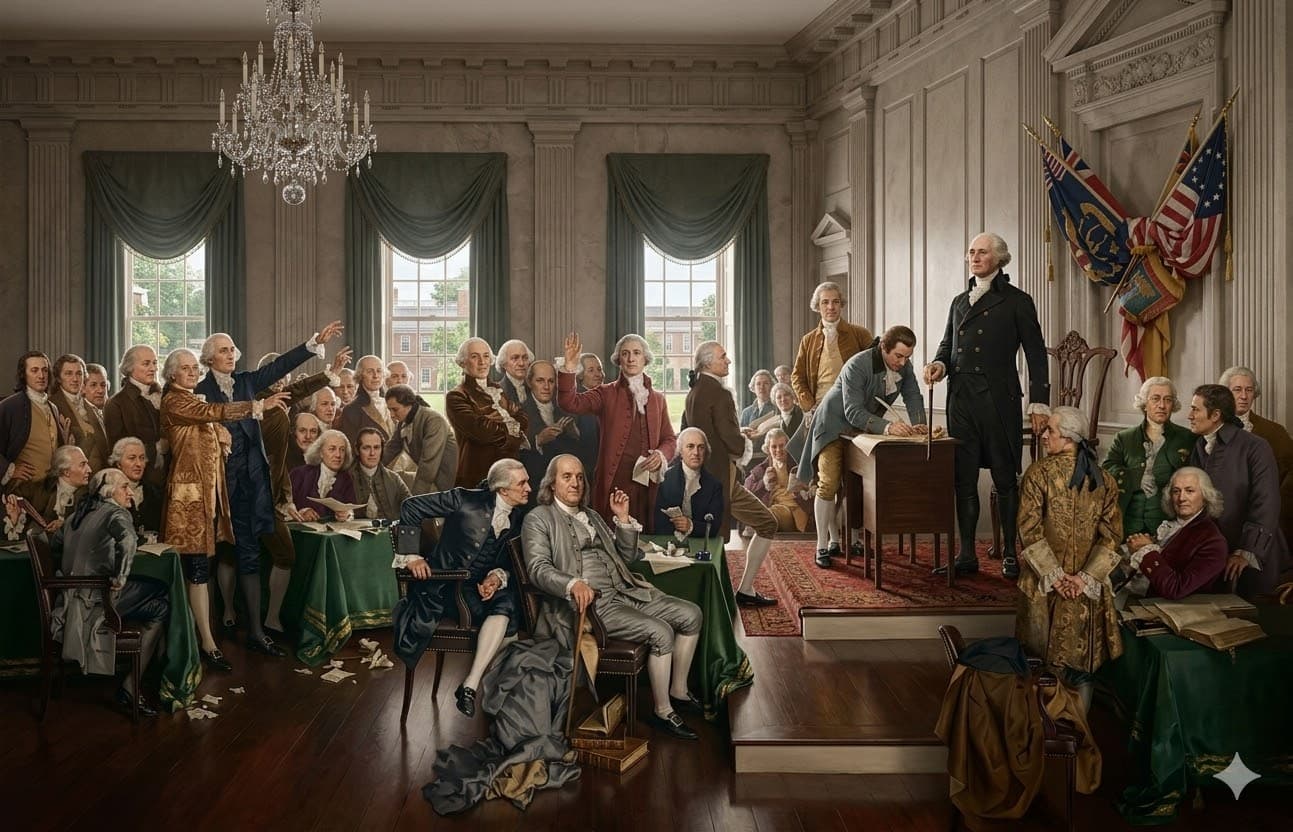
Philadelphia, summer of 1787. Fifty-five delegates spent four months arguing about the shape of a new government. They debated the structure of the Senate for weeks. They fought over presidential power until tempers nearly ended the Convention. They designed an elaborate Electoral College to insulate the presidency from both monarchy and mob rule. Alexander Hamilton, in Federalist No. 68, promised the system would ensure "a moral certainty that the office of President will never fall to the lot of any man who is not in an eminent degree endowed with the requisite qualifications" [1].
For all this deliberation, one question received almost no attention: how individual elections would actually be counted.
The answer they defaulted to was first-past-the-post, or plurality voting. Whoever gets the most votes wins; everyone else gets nothing. It was the method they knew from English parliamentary elections, simple enough to require no debate. Article I gave states control over "the times, places and manner of holding elections." Most states chose single-member districts with plurality winners, because that was what English-speaking peoples had always done.
This was the most consequential non-decision in American constitutional history. In 1951, French political scientist Maurice Duverger identified why: plurality voting in single-member districts tends, by mathematical necessity, to produce a two-party system [2]. The mechanism is elegant and merciless. Under first-past-the-post, the candidate with the most votes takes the seat; second place wins nothing. Votes cast for any candidate outside the top two are wasted, producing no representation whatsoever. Rational voters, anticipating this, abandon their preferred third-party candidate and vote for the lesser evil among the two viable options. Political entrepreneurs, meanwhile, decline to form third parties in the first place, because they know voters will defect.
Gary Cox formalized this as the M+1 rule: in any district awarding M seats, only M+1 candidates can survive strategic coordination [3]. With M equaling 1 (the number for every American congressional and Senate race), only two survive. Across 54 democracies, Cox found a tight correlation: first-past-the-post systems with single-member districts converge on approximately 2.0 effective parties per district. Proportional systems with multi-member districts produce four to eight [3].
The founders built a government with extraordinary care for separating powers, checking ambitions, and distributing authority. They did not build a voting system. They installed a default, and the default had a consequence they could not have foreseen: it would lock the nation into a permanent binary.
When the Bug Was a Feature
For most of the twentieth century, the two-party system's deepest structural flaw (that it compressed all political disagreement into a single axis) was masked by something unexpected. The parties themselves were ideologically incoherent.
The Democratic Party under Franklin Roosevelt assembled a coalition so internally contradictory that it could only govern through constant compromise. Northern labor unions sat alongside Southern segregationists. Urban Catholic machine politicians shared a ballot line with rural white Protestants. African Americans, drawn to FDR's relief programs, voted alongside the very Dixiecrat senators who blocked civil rights legislation at every opportunity.
The Republican Party mirrored this scramble in reverse. Jacob Javits of New York and Clifford Case of New Jersey were committed liberals who supported civil rights, labor protections, and environmental regulation. They belonged to the same party as Barry Goldwater's Western libertarians and the business conservatives of the Sun Belt. Nelson Polsby observed that the two-party label concealed "something more like a hundred-party system," given the variation in party culture across fifty states [4].
This internal incoherence produced an era of remarkable legislative productivity. David Mayhew's landmark 1991 study found that divided government did not significantly reduce legislative output between 1946 and 1990 [5]. The reason was structural: when both parties contained genuine ideological diversity, cross-party coalitions could form on any given issue regardless of which party held formal control.
The passage of the Civil Rights Act of 1964 shows the point with uncomfortable specificity. Republican senators voted 27 to 6 in favor, an 82% rate of support. Northern Democratic senators voted 46 to 1. Southern Democratic senators voted 1 to 20. The bill passed because Senate Minority Leader Everett Dirksen, a Republican from Illinois, worked with Majority Leader Mike Mansfield to assemble a cross-party supermajority that broke a 72-day Southern filibuster. In a Congress sorted into ideologically pure parties, that collaboration would have been structurally impossible.
The system functioned because the parties operated as gatekeepers. Before the McGovern-Fraser reforms of 1969 to 1972, candidate selection was controlled by party professionals. Convention delegates were chosen by state party organizations, not primary voters. Officials like Richard Daley of Chicago preferred electable candidates over ideologically pure ones, because their organizational power depended on winning general elections [4]. The system was undemocratic in its candidate selection. It was remarkably effective in its governance.
That arrangement ended in 1968.
The Code Gets a Patch
The 1968 Democratic Convention in Chicago nominated Hubert Humphrey for president despite the fact that he had not entered a single primary. Eugene McCarthy, the antiwar candidate who had won primaries, was sidelined by party insiders. When police beat antiwar protesters outside the convention hall on national television, the old system's legitimacy collapsed overnight.
The McGovern-Fraser Commission, created to democratize the nominating process, was what Nelson Polsby called "the most consequential change in the American political system" since universal suffrage [4]. Primaries and caucuses replaced closed-door selection. Demographic representation requirements opened the process to women, minorities, and young voters. Party professionals lost their veto over nominees.
The first beneficiary of the new rules was George McGovern himself, who won the 1972 Democratic nomination and then lost 49 states to Nixon. But the deeper consequence took decades to register. Power had shifted from professionals who prioritized electability to primary voters who prioritized ideological consistency. Since primary turnout rarely exceeds 20% of eligible voters, and since primary electorates are systematically more extreme than the general public, the nominating process became a filter that selected for candidates at the poles [7].
The parties sorted in parallel. The civil rights realignment drove Southern whites into the Republican Party and cemented African Americans as near-unanimously Democratic. The college-educated professional class, once reliably Republican, drifted left. Working-class whites, once the backbone of the New Deal coalition, drifted right. Bill Bishop documented in The Big Sort that the share of Americans living in politically homogeneous "landslide counties" roughly doubled between 1976 and 2004, from 26.8% to 48.3% [20]. By 2014, Pew Research found that 92% of Republicans were to the right of the median Democrat, and 94% of Democrats were to the left of the median Republican [6]. The ideological overlap that had made cross-party coalitions possible had essentially vanished.
The two-party system hadn't changed. The parties inside it had. And without the internal diversity that once forced moderation, the first-past-the-post system's compressive logic began doing exactly what Duverger predicted: reducing all political conflict to a zero-sum war between two hostile camps.
The Data Scalpel
If partisan sorting was the slow geological shift, the algorithmic revolution in redistricting was the earthquake.
Gerrymandering is older than the republic. Elbridge Gerry signed a Massachusetts redistricting map so contorted it resembled a salamander in 1812. But what happened after 2010 was categorically different. The Republican State Leadership Committee's REDMAP initiative invested $30 million in targeted state legislative races specifically to control redistricting after the census [8]. The investment's return was extraordinary. By capturing legislatures in Pennsylvania, Ohio, Michigan, Wisconsin, and North Carolina, Republicans drew congressional maps that locked in structural House majorities for a decade.
The mathematics were brutal. In Pennsylvania's 2012 congressional races, Democratic candidates received 51% of the total vote. Republicans won 13 of 18 seats: a 72% seat share from a 49% vote share [8]. In Michigan, Democrats won 53% of the vote and 36% of the seats. These outcomes were not flukes of political geography. They were engineered, using software that could evaluate thousands of possible district configurations and select the one maximizing partisan advantage [9].
David Daley, who documented the REDMAP strategy in forensic detail, articulated the inversion at its core: "The people no longer choose their representatives; the representatives choose their people" [8]. This is not rhetoric. Algorithmic redistricting allows map-drawers to design districts where the partisan outcome is predetermined regardless of how the electorate actually votes. The Supreme Court, in Rucho v. Common Cause (2019), acknowledged that partisan gerrymandering was "incompatible with democratic principles," then ruled it a "political question" beyond the reach of federal courts [10]. Justice Elena Kagan, dissenting, wrote that the majority had decided "to let politicians gerrymander the electorate to their hearts' content" [10].
The Brennan Center estimated that maps used in the 2024 election contained, on average, a net 16 fewer competitive or Democratic-leaning districts than maps drawn under fair anti-gerrymandering standards [9]. Sixteen districts may sound modest. In a House with razor-thin margins, it is the difference between functional governance and perpetual gridlock.
The Doom Loop
The structural effects of these changes compound one another in ways that resist easy intervention.
Consider the arithmetic. FairVote's 2022 analysis found that 359 of 435 House races were decided by margins exceeding 10 percentage points. The average margin of victory was 28 points [11]. In those non-competitive districts, the general election is a formality. The only election that matters is the primary, where turnout in 2022 averaged just 21.3% of eligible voters [7]. Run the numbers: approximately 8% of the American electorate effectively chose 83% of the House of Representatives [11].
That 8% is not a random sample. Primary voters are, by every available measure, more ideologically extreme, more partisan, and more hostile toward the opposing party than the general public [7]. They are the fraction of the electorate for whom politics is identity, not obligation. A legislator who appeals to this electorate by reaching across the aisle does not earn goodwill. They earn a primary challenger.
This is the incentive architecture that Alan Abramowitz and Steven Webster identified as "negative partisanship": Americans now align against the opposing party rather than for their own [12]. Pew Research documented the escalation: by 2022, 72% of Republicans and 63% of Democrats viewed members of the opposing party as more immoral than other Americans, up from 47% and 35% just six years earlier [13]. Shanto Iyengar and Sean Westwood found that hostile feelings toward the opposing party had become "ingrained and automatic," comparable in measured intensity to racial prejudice [14].
The critical insight is that this is not primarily a story about attitudes. It is a story about structure. Morris Fiorina's research has shown repeatedly that ordinary Americans remain moderate on most policy questions [15]. The polarization visible in Congress is concentrated among elites and politically active minorities. If the public is moderate but its representatives are extreme, the question is not "What is wrong with the voters?" The question is: what is wrong with the selection mechanism? The answer: a primary system that gives a small, unrepresentative, ideologically committed fraction of the electorate veto power over who appears on the general election ballot.
The consequences register in every measure of institutional health. Senate cloture motions (the procedural mechanism for breaking filibusters) numbered 336 in the 117th Congress, compared to 60 in the early 1990s [16]. As many cloture motions were filed in the last decade as in the entire 60-year period from 1947 to 2006. Trust in the federal government has cratered: only 16% of Americans say the government does the right thing always or most of the time, down from 73% in 1958 [13]. Congressional approval hit 12% in early 2024 [16]. Steven Levitsky and Daniel Ziblatt identified this erosion of mutual toleration and institutional forbearance as the mechanism by which democracies die from within [17].
The loop is self-reinforcing. Safe districts produce extreme candidates. Extreme candidates produce performative governance. Performative governance erodes public trust. Eroded trust drives down general election turnout, which concentrates even more power in the hands of primary activists. Each cycle ratchets the system further from the center.
Root Access
The doom loop has a second-order consequence that rarely enters the polarization debate, because it is embarrassing to both parties. Once a legislator's seat is safe (and 359 of 435 House seats qualify), winning reelection requires only one thing: staying on the right side of a low-turnout primary electorate that evaluates candidates on tribal loyalty, not job performance. That is a low bar. It takes a few cable news hits, a reliably partisan voting record on marquee culture-war issues, and an opponent to demonize. It does not take legislating.
The rest of a representative's time, energy, and attention is structurally unaccounted for. And the data on where it actually goes is damning.
Lawrence Lessig, the Harvard law professor who has spent two decades studying what he calls "dependence corruption," documented that the average member of Congress spends between 30% and 70% of their working hours fundraising [22]. Not governing. Not drafting legislation or conducting oversight. Dialing donors. The average House member must raise approximately $16,000 per day, every day of their term, to fund the next campaign [22]. A legislator running that treadmill does not need to be bribed to attend to donor interests. The fundraising schedule itself colonizes their attention, their sense of which problems matter, and their instinct for which solutions are "realistic."
Martin Gilens and Benjamin Page tested what this produces at the policy level. Their 2014 study analyzed 1,779 policy cases from 1981 to 2002, comparing the preferences of average citizens, economic elites, and organized business groups against actual legislative outcomes. The finding was blunt: "Economic elites and organized groups representing business interests have substantial independent impacts on U.S. government policy, while average citizens and mass-based interest groups have little or no independent influence" [21]. Even when 80% of the public supported a policy position, it became law only about 43% of the time if elites opposed it. The preferences of ordinary voters, once elite and business preferences were controlled for, had a statistically near-zero effect on outcomes [21].
The revolving door completes the incentive structure. Lee Drutman documented that the average House member who leaves Congress for a lobbying career earns 1,452% more than their congressional salary [23]. Corporate lobbying spending grew from roughly $100 million in 1975 to over $3.4 billion annually by 2014, and the corporate-to-public-interest spending ratio widened from rough parity to 34-to-1 [23]. A legislator who cooperates with industry interests during their time in office is not merely doing a favor; they are investing in their own post-congressional compensation. A legislator who challenges those interests is forfeiting a future worth millions.
The ethical failures that periodically surface are not aberrations within this system. They are its predictable output. When ProPublica reported in 2023 that Justice Clarence Thomas had received over $4 million in undisclosed gifts, luxury travel, and real estate transactions from Texas billionaire Harlan Crow over two decades, the structural question was not why Thomas accepted the gifts [24]. It was why the system contained no mechanism to prevent or punish it. The Supreme Court had never adopted a binding code of ethics. When it finally did, in November 2023, the code contained no enforcement provision. Compliance is self-monitored [24].
The pattern extends wherever accountability depends on institutions policing their own. The Jeffrey Epstein case crystallized the problem in its starkest form. Federal prosecutor Alexander Acosta negotiated a secret 2008 non-prosecution agreement that granted immunity not only to Epstein but to "any potential co-conspirators," a provision so broad it shielded an undefined network of associates from scrutiny [25]. When Julie K. Brown's reporting for the Miami Herald forced the case back open and Epstein was arrested on federal trafficking charges in 2019, he died in federal custody before trial. The DOJ Inspector General documented a "series of failures" at the Metropolitan Correctional Center: sleeping guards, falsified records, corrupted camera footage, removal from suicide watch, and transfer of his cellmate the night before his death [25]. Whether those failures were negligence or something worse, the systemic effect was identical: accountability was extinguished before it could reach anyone beyond the principal defendant.
What connects Thomas's undisclosed gifts, Epstein's neutralized prosecution, and the daily grind of congressional fundraising is not a conspiracy. It is an incentive architecture. Safe seats free legislators from electoral accountability to the general public. That freedom is then filled by the interests with the most resources and the most to gain: the donor class, the lobbying industry, and the network of institutions that profit from a government too captured to regulate and too gridlocked to reform. The base gets the rhetoric. The donors get the policy. And when the contradictions occasionally surface, tribal loyalty ensures that voters will not cross party lines to punish their own.
This is the final mechanism by which structural polarization corrodes democratic governance. It is not enough that the system produces extreme candidates and performative conflict. The system also produces a permanent class of incumbents who face real consequences for bipartisan cooperation but no consequences whatsoever for corruption, self-dealing, or simply doing nothing.
Running the Upgrade
The diagnosis is structural. So is the prescription.
Four institutional reforms have accumulated enough evidence from real-world implementation to deserve serious evaluation. None is untested theory. Each has been adopted in at least one American jurisdiction, and the early results, while not definitive, are consistently positive.
Ranked Choice Voting changes what candidates must do to win. Under plurality rules, the optimal strategy is base mobilization: energize supporters, tear down the opponent. Under RCV, candidates need second-choice votes from supporters of eliminated candidates, which rewards broader appeals. Alaska and Maine have adopted RCV for statewide elections. In Alaska's 2022 special election, Mary Peltola won a House seat as a Democrat in a state Trump carried by 10 points, building a coalition that included second-choice support from moderates who had ranked other candidates first [11].
Open or nonpartisan primaries dilute the ideological-activist veto. California's top-two primary system, adopted in 2010, sends the two highest vote-getters to the general election regardless of party. In safe districts, this means two candidates from the same party compete in November, with the more moderate candidate holding a structural advantage because they can appeal to the full electorate rather than a partisan primary base.
Independent redistricting commissions address the fundamental conflict of interest in having legislators draw their own districts. California's Citizens Redistricting Commission, created by Proposition 11 in 2008, uses 14 citizens selected through a vetting process that excludes elected officials, political consultants, and campaign donors. The Supreme Court upheld the citizen commission model in Arizona State Legislature v. Arizona Independent Redistricting Commission (2015), ruling 5 to 4 that the people's power to legislate through ballot initiative satisfies the Elections Clause.
Multi-member districts with proportional representation attack the root cause identified by Duverger. In a five-seat district, a party winning 20% of the vote wins one seat instead of zero. Arend Lijphart's analysis of 36 democracies found that proportional representation systems produce lower polarization, higher voter turnout (five to seven percentage points higher on average), and better representation of women and minorities [18]. Lee Drutman's argument is specifically American: in a two-party system, every election becomes an existential zero-sum contest, with no structural outlet for moderation or coalition-building [19]. A multiparty system would allow voters to express preferences more precisely and force the kind of post-election governing coalitions that are standard practice in most developed democracies.
These reforms face an obvious obstacle. The politicians who would need to enact them are precisely those who benefit from the current arrangement. Asking incumbents to dismantle the system that keeps them in office is asking the fox to redesign the henhouse.
But the state-level track record suggests a different path. Every major reform listed above was adopted through ballot initiative or citizen referendum, not legislative action. California, Alaska, Maine, Arizona, Michigan, Colorado: the pattern is consistent. When voters are given the opportunity to restructure the system directly, they do.
The Bug Report
The American political crisis has the texture of a culture war: neighbors who can't speak to one another, Thanksgiving dinners ruined by politics, social media feeds that feel like dispatches from separate countries. That texture is real. But it is a symptom, not a cause.
The cause is an operating system installed in 1787, never updated for the world it now runs in. First-past-the-post voting was a reasonable default for a pre-industrial republic of 3.9 million people spread across thirteen coastal states. It is a catastrophic mismatch for a continental nation of 330 million sorted into ideologically homogeneous communities, whose elections are drawn by algorithms and funded by data-targeted billions.
The founders were not fools. They were engineers working with the materials they had, solving the problems they could see. They could not have anticipated Duverger's Law, because political science did not yet exist as a discipline. They could not have foreseen algorithmic redistricting, because computers would not be invented for another century and a half. They did anticipate faction. Madison warned in Federalist No. 10 that faction was "sown in the nature of man" and could only be controlled through structural design, never through appeals to virtue.
He was right about the diagnosis. The structure he built is now the source of the very dysfunction he feared. And the fix, as Madison would have understood, is not moral persuasion. It is better architecture.