
The Confusion at the Center
Dario Amodei, the CEO of Anthropic, said in late 2025 that AI could displace half of all entry-level white-collar jobs within five years [16]. Unemployment among 20- to 30-year-olds in tech-exposed occupations climbed nearly three percentage points over the course of 2025 alone. AI was cited as a factor in roughly 55,000 U.S. layoffs that year, a small fraction of the 1.17 million total, but a number that was zero just three years earlier [6].
These are real numbers attached to real careers. And the instinct they produce, visceral fear that AI will simply erase human labor, is both understandable and wrong.
The dominant framing of AI and work is a zero-sum contest: machine versus human, with the machine winning. This framing confuses the automation of specific tasks with the obsolescence of entire roles. David Autor, the MIT economist who has studied automation for two decades, draws a critical distinction: technology displaces tasks, but it also creates new comparative advantages for human labor, and almost always has [4]. Roughly 60% of the jobs Americans hold today didn't exist in 1940. The World Economic Forum's 2025 report projects AI will create 97 million new roles globally while displacing 85 million, a net positive of 12 million jobs by 2030 [3].
The story of AI and work is not one of erasure. It is one of reallocation, of skill, capital, and institutional power. But that word, reallocation, should not be mistaken for painless. The same McKinsey research that projects a roughly neutral net effect on total employment also estimates that 400 to 800 million individuals may need to change occupations by the end of this decade [1]. A neutral aggregate can hide a brutal transition for individual workers and entire industries. The question is not whether the economy will adapt. It always does. The question is whether you will adapt, and whether the institutions around you will help or hinder that process.
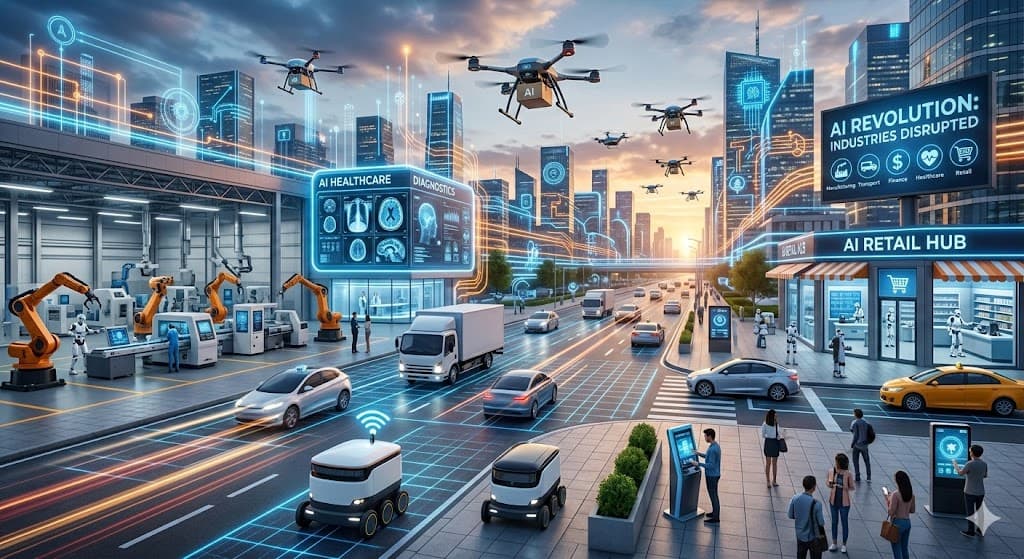
The Kill Zone: Industries on the Front Line
The disruption is not hypothetical, and it is not evenly distributed. Some industries are already deep into structural reorganization. Others have perhaps eighteen months before the transformation becomes undeniable.
Law is among the furthest along. AI platforms like Harvey.ai can now perform contract review, legal research, and document analysis that once occupied armies of junior associates billing by the hour [13]. A single attorney working with an AI-powered research tool can synthesize relevant case law, asking a natural language question and receiving a summarized answer with citations, in minutes rather than hours. The profession is not shrinking so much as reshaping: Reed Smith, a major global law firm, now employs a "Director of Applied Artificial Intelligence," a senior role that did not exist three years ago [13]. The displacement is concentrated at the entry level. The growth is at the intersection of legal expertise and AI fluency.
Healthcare administration faces a similar pattern, though the clinical side of medicine is being augmented, not replaced. Medical coding, billing, insurance claims processing, and prior authorization, the bureaucratic infrastructure of American healthcare, are being automated at speed. But the deployment of clinical AI creates its own workforce demand. Viz.ai, which offers over 50 FDA-cleared algorithms for analyzing medical imaging, requires hospitals to hire clinical AI specialists and medical AI auditors to validate performance, train clinicians, and manage system integration [14]. The Chief AI Officer is becoming a real position in hospital C-suites.
Financial services are compressing entry-level roles in accounting, auditing, and credit analysis while expanding demand for professionals who can manage AI-driven fraud detection, compliance monitoring, and algorithmic risk assessment. The BLS projects that office and administrative support occupations will decline 4.1% over the next decade [5]. That is a modest-sounding number until you realize it represents hundreds of thousands of specific human careers.
Software engineering, the industry that built AI, offers the most striking case. By late 2025, tech employment had fallen below its projected trend line, and early-career software roles showed measurable declines [6]. An engineer using an AI coding assistant can build and iterate on a product at a velocity that makes a traditional five-person team redundant for many tasks. This does not mean software engineers are disappearing. It means the floor of competence has risen dramatically, and the roles that remain demand a different kind of expertise: systems thinking, architectural judgment, and the ability to direct AI agents rather than write boilerplate.
Content and creative work has been the most publicly visible disruption. AI can generate first drafts of ad copy, blog posts, marketing emails, social media content, and basic graphic design at a scale and speed no human team can match. A single marketing professional can now oversee a hyper-personalized campaign that would have once required a department. The work that survives is strategic: brand voice, creative direction, audience insight. The executional layer is gone.
The pattern across all of these industries is consistent: routine cognitive tasks contract, while roles that combine domain expertise with AI fluency expand. The WEF estimates that 50% of all employees will need reskilling by 2027 [3]. That is not a projection about the distant future. It is a statement about the next twelve months.
The Garage and the Goliath
The disruption to individual careers is matched by a structural disruption to the organizations that employ them. For a century, competitive advantage was a function of scale: larger headcounts, bigger factories, deeper capital reserves. AI is inverting that logic with startling speed.
Ben Thompson, the technology analyst, argues that AI represents a "final unbundling" of the value chain [8]. The internet unbundled distribution: anyone could publish, broadcast, or sell to a global audience. AI is now unbundling creation and substantiation. An individual or small team no longer needs massive resources to create compelling products. Their ideas can be substantiated, designed, coded, tested, marketed, by AI.
The practical implications are severe for incumbent firms. A startup built on an AI-native architecture from day one carries no technical debt, no rigid human-centric workflows, no committees or approval chains. It can use AI to analyze markets, develop software, generate content, and manage customer relationships. A traditionally structured competitor staffs each of those functions with entire departments [7]. Harvard Business Review has argued that generative AI could supplant traditional enterprise SaaS entirely, replacing structured menus and predefined workflows with intent-driven systems where users simply describe what they want [9].
This is not a theoretical risk. The phrase "one-person unicorn" (a billion-dollar company with a single employee augmented by AI) was a thought experiment two years ago. It is becoming a credible business model. The true threat of AI is not to the factory worker or the freelancer. It is to the vertically integrated incumbent firm whose organizational mass becomes a liability rather than an asset.
The New Engineering Class
Displacement is only half the story. AI is simultaneously constructing an entirely new professional class, and the demand is intense.
The most direct evidence comes from the tools themselves. Frameworks like LangChain, LlamaIndex, and crewAI are not hobbyist projects; they are enterprise-grade platforms adopted by Salesforce, Rakuten, Klarna, and Cisco [15]. The engineers who build on these platforms are not traditional software developers. They combine coding with business process analysis, instructional design for AI agents, and deep intuition about how large language models behave. A crewAI engineer, for instance, designs teams of AI agents, defining each agent's role, goal, backstory, and tools, then orchestrates them to execute complex business workflows like due diligence or competitive analysis. This is a form of cognitive systems architecture that did not exist as a discipline three years ago.
Beyond the core technologists, every industry that adopts AI generates its own specialist roles. Legal AI specialists manage and validate tools like Harvey. Clinical AI auditors ensure that hospital imaging algorithms perform within safety tolerances. Chief AI Officers oversee institutional strategy. Data ethicists evaluate bias, fairness, and privacy. AI governance professionals draft and enforce the policies that determine how these systems interact with the public [15]. McKinsey estimates that generative AI could add $2.6 trillion to $4.4 trillion in value annually to the global economy [10]. A significant share of that value will be captured by workers in roles that are being invented right now.
The ripple extends further. As AI automates routine cognitive tasks, the economic value of uniquely human skills rises. Fields that require empathy, physical dexterity, and creative judgment will see relative growth, not because they are immune to AI, but because AI augments them without replacing the core human element [2, 12]. A therapist who uses AI to summarize session notes can see more patients. A master craftsperson who uses AI for design modeling can take on more ambitious projects. The labor market is developing what economists call a "barbell" shape: rapid growth at both ends, in highly technical AI roles and in deeply human-centric ones, with a hollowing out of routine cognitive work in the middle.
The Pre-Boom
AI is not merely another tool. It is a general-purpose technology, the kind that appears perhaps once per century, and its primary economic impact lies not in what it does directly but in what it enables.
The most useful analogy is the internet itself. The real economic transformation of the internet came ten to fifteen years after the initial hype cycle. The dot-com bubble of the late 1990s was built on primitive web pages and clumsy e-commerce. The transformative applications (social networks, cloud computing, mobile ecosystems, the gig economy) emerged a full decade later. Current large language models are the equivalent of those mid-90s web pages: impressive in isolation, but nowhere near the capabilities that will emerge as the technology matures.
The applications that will generate the most value and the most jobs are ones we can barely describe today. What we can identify are the frontier research areas where AI is already accelerating progress: drug discovery through protein folding and molecular interaction modeling, materials science through the design of novel alloys and polymers, climate science through improved long-range weather forecasting and energy grid optimization [15]. Sequoia Capital calls generative AI a "creative new world" and identifies entire categories of business (synthetic media studios, AI-driven personalized medicine, generative biology) that will constitute new industries, not just new features added to old ones [11].
We are in the pre-boom. The Cambrian explosion of AI-driven innovation has barely started.
The Preparation Imperative
If the analysis above is correct, that AI is driving a massive reallocation rather than a net destruction of work, then the critical variable is not whether jobs will exist but whether workers will be prepared for the jobs that do. The evidence on this point is not encouraging.
The WEF's 2025 report identifies the most in-demand skills for the coming economy: analytical thinking, creative problem-solving, AI and big data literacy, resilience, and flexibility [3]. These are not niche technical competencies. They are foundational cognitive skills that most educational systems do not explicitly teach and most corporate training programs do not prioritize.
The economist Daron Acemoglu, whose work on automation is among the most cited in the field, offers a pointed warning. Historically, the "reinstatement effect" (the creation of new tasks where humans have a comparative advantage) has consistently outpaced the "displacement effect" of automation [2]. But Acemoglu stresses that the speed of transition matters enormously. Too-rapid displacement without reinstatement creates real social friction: unemployment spikes, community decline, political instability. The reinstatement effect is not automatic. It depends on institutions, educational, corporate, and governmental, responding quickly enough to retrain and redeploy displaced workers.
What does preparation look like in practice?
First, AI literacy is becoming a baseline professional skill, not a specialization. Understanding how AI models work, what they can and cannot do, and how to communicate with them effectively (what some call prompt design) is the equivalent of learning to use spreadsheets in the 1980s or email in the 1990s. Professionals who lack this literacy will find themselves functionally illiterate in their own industries within a few years.
Second, the most productive model of human work in an AI-augmented economy is the centaur, a term borrowed from chess, where human-AI teams consistently outperform either humans or AI alone [12]. The centaur model requires a specific mindset: not competing with AI for cognitive speed, but directing AI toward problems that require judgment, context, and ethical reasoning. A lawyer who becomes an expert user of Harvey is more valuable than one who ignores it. A radiologist who integrates Viz.ai into her diagnostic workflow is more accurate than one who relies solely on her own eyes.
Third, the geopolitical dimension cannot be ignored. The United States, the European Union, and China are pursuing radically different AI strategies. The U.S. prioritizes private-sector innovation with minimal regulation. The EU, through its AI Act, prioritizes trust, safety, and the protection of fundamental rights. It is the world's first comprehensive legal framework for AI [17]. China directs AI development from the state level, treating it as a tool of national power. The regulatory environment in which a worker operates will shape which skills are rewarded, which jobs exist, and how quickly the transition unfolds.
Goldman Sachs projects a relatively modest and temporary half-percentage-point increase in unemployment during the AI transition period [6]. That projection assumes that workers, firms, and governments all respond adaptively. It is, in other words, a best-case scenario.
What the Numbers Don't Capture
The pace of AI development is exponential, not linear. Model capabilities are doubling every few months, a rate of progress that human intuition, calibrated for gradual change, consistently fails to anticipate [7]. The workplace of 2030 will be further from today than today is from 2020. The BLS projects total U.S. employment growing from 161.8 million to 169.4 million over the next decade, net positive despite AI adoption [5]. But those aggregate numbers conceal a churning interior: entire categories of work being dissolved and reformed, industries reorganizing around AI-native architectures, and a professional class emerging that did not exist five years ago.
The critical point is not that AI will destroy more jobs than it creates. The evidence, taken as a whole, suggests it won't [3, 4, 5]. The critical point is that the jobs it creates will require fundamentally different skills than the jobs it displaces. The transition between those two states, the space where real people lose real careers and need to build new ones, is where the human cost concentrates.
The great reallocation is not an event on the horizon. It is the ground shifting beneath your feet. The question is no longer whether to prepare, but whether you have already started.